|
|

楼主 |
发表于 2018-2-19 09:54:46
|
显示全部楼层
本帖最后由 Oeasy 于 2018-2-19 10:34 编辑 9 C4 \# } B7 `; {$ d, Y: }. R9 p
yingyuxx 发表于 2018-2-19 01:07
% G: m i8 n0 L+ ?) k; x6 r- RI’d try to get there early if you can.. s2 q" A2 t1 r. u
原译:要是你可以早到,我也会尽量早到。
* e/ U+ \; T# U, w% A9 d( c4 M张译:我建议你尽量 ...
7 ]/ t& L2 P" K3 I1 x+ V& P
& v% t. {9 Z7 C& i' k2 N/ O
记录下我的思考,不是为了争个对错高低哈。
+ A' d" G& A2 ]- W" m1 ^4 P% @+ @: S) q4 _
对比下 LAAD2 和 LDOCE5 。& R2 o& s; X& Z' [1 N3 ?% Z* a4 e
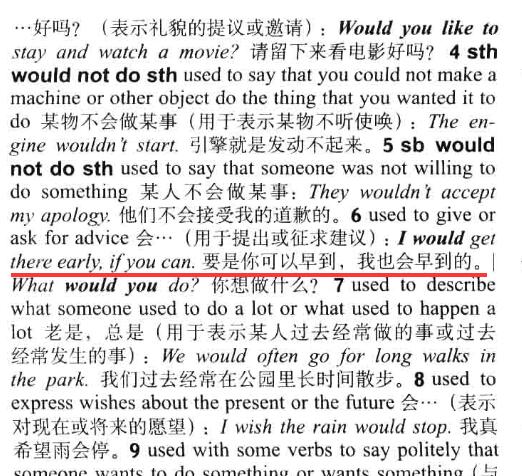
LAAD2(2007) » I would get there early, if you can. 要是你可以早到,我也会早到的。(2000 年第一版 LAAD 并没有这个例句,从时间判断,这个句子是改编自 LDOCE 的)8 d# h% o5 z6 i' }
LDOCE4/5(2003、2009) » I’d try to get there early if you can. 要是你可以早到,我也会尽量早到。) _ I# [8 D! c4 h; _4 T% \, ?, _) o
7 t: a& V/ S+ ULDOCE 多了 try to ,直觉上讲,假如 you 可以早到,接下来要说的就是 I 也可以、必须、应该、肯定、坚决地要早到,你早到了我再晚到有点不太好吧,而不单单是 try to (尽量)早到。你都早到了,我还只是尽量早到,那这个你早到,有什么意义?
! |& X( n$ H" i* W( k
' ~% `9 N I8 |! P" n8 |" DLDOCE 里的 would 以及 try to ,其实让我倾向于 I 有不去的可能性,为什么呢?假如我要去的话,我倾向于这样说:
( l3 {% a/ a2 R1 b( l; r- I will/can/would/could get there early if you can/could. 也就是如 LAAD2 那样,去掉 try to 。
' V: ]2 |% c/ a+ }( v; L* A
$ D( p8 H, j( `0 ^# I, w1 U7 R就算用 try to ,因为已经假设我肯定是要去的,我倾向于用 I will try to 而不是 I would try to 。
* g& j) t* t X0 s+ g+ I. o
9 m1 w5 @( D7 x- c g6 n! }LDOCE » I’d try to get there early if you can. 要是你可以早到,我也会尽量早到。
! `$ \- {3 ^: v0 a9 M完整的表达可能就是:If I were you, and if I(= you)can get there early, I(= you) would (try to) get there early. (我是你的话,我能早到就尽量早到。)
, _$ r0 ]; O0 W! ?3 o: n/ L& D+ H8 v+ x
当然,这句子上下文到底如何,是不是编辑自己造的,就不得而知了。
2 D( b7 _& C4 L9 ]6 \# G! d% ^) D, x& H- w6 ~: p# _
---
3 I! Q+ p9 @: p. V1 S3 k% J: `
4 V1 B* [$ [1 S8 b' _& c5 H* |衍生讨论,I will 和 I would 的区别。
! Z; s5 Q3 ^: U! O
" k' i9 \# q5 j" t! V$ ~. b- What is the difference between I will try it. and I would try it. ? https://hinative.com/en-US/questions/379583# F4 ]& Q# z, a6 p5 p$ k
$ D2 c7 X2 ]5 x+ K5 e9 y( j
I would get there early, if you can.! {0 b5 K& \4 ?/ v7 V8 h
I will get there early, if you can.% ]6 E& p) J3 |: r R- K2 T
$ P' d- O9 F2 Y( I# D. `7 S8 m
同为非过去时,I would 更加委婉。4 U% e# e' f" l2 T5 h1 D- Z( o o) a
% W# L& W$ `/ {## 柯林斯5 l/ {5 d' G, Z* W( m$ o
I will be most upset if this book does not bring home the bacon. 我就不信这本书不畅销。6 U8 I/ R! p& z
I'm working on my fitness and I will be ready in a couple of weeks, if not sooner... 我正在调养身体,最多两三周以后就可以了。* _/ g% P( l) j" R9 q$ `0 S. j
I am not going to reveal what my seven-year plan is, but I will tell you this much, if it works out, the next seven years will be very interesting. 我不想透露我的七年计划的具体内容,不过有一点可以告诉你,如果顺利实施,今后的七年将非常有意义。* _" N! V' E4 g: N' s+ v3 G3 w( {
q5 r% k* W% U0 V, r6 \* G/ M## 剑桥( r* E3 C$ k4 r) v
If you tell them what happened I will bear you out (on it).如果你告诉他们所发生的事,我会为你作证的。
! Z! L% k' r( f& F. N" [$ v! bI have a lot of money riding on that horse (= I will win or lose a lot of money if that horse wins or loses the race).我在那匹赛马上押了很多钱。4 v* Z' A0 [, P$ i* d( n
I'll meet you in the city, that is, I will if the trains are running.我将在城里与你会面,那就是说,只要火车还开我就会见到你。, @' o+ {5 B8 [, C# t: x, A
Unless you call me to say you're not coming, I'll see you at the theatre (= I will see you there if you do not call to say you are not coming).除非你打电话说你不来了,否则我就在剧院等你。3 n5 F! H: |+ ^) g
Put that ball down and come over here, Laura - I'm warning you (= I will punish you if you do not)!放下那个球到这儿来,劳拉——我是在警告你!
" |* o: V; `: ?: u: ^. Z
0 Y. W- w N* E$ \## 牛津
( G7 I! L( r# NI don't care (= I will not be upset) if I never see him again! 即使我永遠再也見不到他,我也不在乎!$ t" _( A( g" X' a# f& \" w, P4 g
. x" [4 I7 ~7 \, t% P) D1 l" q7 l& q8 w$ Y! a# w% I9 K5 u0 f
|
|
 楼主: Oeasy




 发表于 2018-1-6 00:16:11



 _4 [3 Y3 X4 H
 " J0 _+ N- R h* K$ H